Material Thinking
The way that I relate to materials was very much influenced by Paul Carter’s Material Thinking ideas and my further research into the concept. Material thinking became the starting point and launching pad into a practice which prioritises the materials and the intrinsic experience with them. My thinking around the way that I worked shifted into having more of a relationship with the materials rather than just using them, it became a more intuitive way of working. This research into Material Thinking also sparked my interest in related concepts of material agency, ideas of embodiment and in works that are immersive experiences.
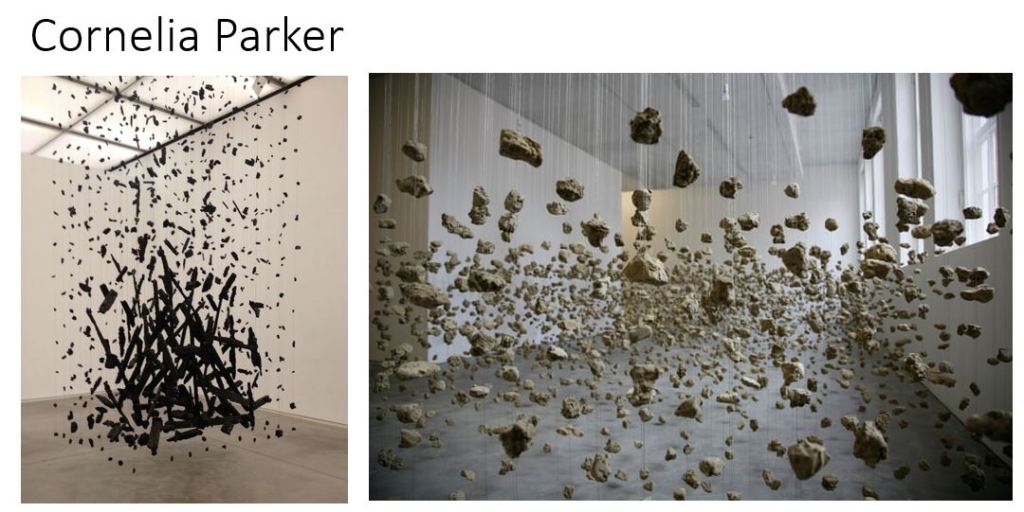
Following research into Material Thinking I found Cornelia Parker, and took inspiration from her making process and the physicality of her works. I liked the energy of her pieces, they are powerful and made to be experienced. Her ideas come through the experience of the work, and through the installation, the nature of the materials comes through to aid with its representation. This can be particularly seen in Cold Dark Matter: An Exploded View, and in Subconscious of a Monument I resonated with the poetically conceptual visual language Cornelia Parker uses, effective in creating works to be embodied and to convey ideas clearly.
Material Agency
Jane Bennett’s Vibrant Matter: A Political Ecology of Things, introduced me to the concept of material agency and Vital Materialism, seeing the energy and the life within a material, while holding onto its physical nature. ‘Every thing is entelechial, life-ly, vitalistic.” It made me consider materials in a different way, holding them with a level of respect and potential. Perhaps also shaping my ideas in my final piece, with seeing the beauty in light.
Poetic Physicality
I looked into the poetics of visual metaphor and the conceptual physicality of a piece. I became interested in language and the correlation between poetry and visual art. How visual art installations don’t need verbal explanations, it becomes something that is primarily felt and embodied. These concepts were discussed in The Language of Twentieth-Century Art: A Conceptual History and The Psychology of Contemporary Art. “meanings (that) are understood intuitively [..] without the need to translate them into their verbal equivalents”. After reading these texts I knew I wanted to create something with a strong physicality and to explore affect and embodiment further.
Affect and aesthetics
In ‘The Aesthetics of Form Knowledge’, Astrid Heiner discusses how knowledge is embodied and comes through your senses, through perception and body memory, the relationship between your body and your experience, as well as knowing through making. This insight strengthened my knowledge in Material Thinking and using your senses in experiencing a work. Christina Murdoch, also talks about the same concepts in ‘Materiality as the Basis for the Aesthetic Experience in Contemporary Art’. She introduced me to the idea of an ‘aesthetic experience’ and this as one being experienced through the senses. Richard Schusterman’s quote on ‘aesthetic experience’ made me further consider and understand an aesthetic experience on a relatable level, and I thought it accurately described what I was trying to create through the experience of my videos, “a phenomenological dimension (something vividly felt and subjectively savoured, affectively absorbing us and focusing our attention on its immediate presence and thus standing out from the ordinary flow of routine experience)” In Materiality as the Basis for the Aesthetic Experience in Contemporary Art, Christina Murdoch talks about how digital works are “one step removed from actual experience” which was something I had also considered. Questioning whether the essence of an artwork remains when it’s viewed through technology. I wanted to combat this issue partially by making my final work a virtual installation, to make it closer to the embodied experience I want to create.
Cosette O’Connell & Ann Veronica Janssens
Cosette O’Connell’s honours exegesis, provided valuable insight into a practice akin to my own. She studied the physical nature of light in an exploratory manner. What was most helpful in the exegesis was the introduction to artist Ann Veronica Janssens.
Watching the ‘Passion for light interview’ with Ann Veronica Janssens, I resonated with the way that she talked about light as a material and as a phenomena to be observed. The way that she perceived light aligned closely with my conceptual ideas and interests. Seeing her ideas so clearly articulated, solidified my own ideas and my understanding about what it was about light that I was interested in. She introduced me to the concept of serendipity and what a ‘time of idleness’ can offer in discovering these phenomenons. I related to this concept entirely, as this was how my first video was filmed, in a time of idleness and in a moment of observation and appreciation. I decided I wanted to continue to capture moments like this one I already had, to make an immersive experience with a series of videos.
References
Bennett, Jane. Vibrant Matter: A Political Ecology of Things. North Carolina, UNITED STATES: Duke University Press, 2010. http://ebookcentral.proquest.com/lib/aut/detail.action?docID=1170671.
Carter, Paul. Material Thinking : The Theory and Practice of Creative Research. Melbourne University Press, 2004.
Crowther, Paul. The Language of Twentieth-Century Art: A Conceptual History. London: Yale University Press, 1997.
Harman, Graham. Art and Objects. Newark, UNITED KINGDOM: Polity Press, 2019. http://ebookcentral.proquest.com/lib/aut/detail.action?docID=5997132.
Heimer, Astrid. ‘The Aesthetics of Form Knowledge: Embodied Knowledge through Materialization’, Studies in Material Thinking, Vol 14 (April 2016). http://www.materialthinking.org/sites/default/files/papers/0176_SMT_V14_P04_FA.pdf.
Kent, Rachel . ‘Cornelia Parker Exhibition’. MCA Australia. Accessed 10 November 2021. https://www.mca.com.au/artists-works/exhibitions/cornelia-parker/.
Louisiana Channel. “Ann Veronica Janssens Interview: Passion for Light.” Video. 2016. https://vimeo.com/184493462
Mills, Christina Murdoch. ‘Materiality as the Basis for the Aesthetic Experience in Contemporary Art’, n.d., 43.
Minissale, Gregory. The Psychology of Contemporary Art. New York, UNITED STATES: Cambridge University Press, 2013. http://ebookcentral.proquest.com/lib/aut/detail.action?docID=1543544.
Musée d’art de joliette. ‘Monika Grzymala – Exhibition at Musée d’art de Joliette – Summer 2018’. Accessed 15 June 2021. https://www.museejoliette.org/en/expositions/monika-grzymala/.
Ónafngreindur. ‘Monika Grzymala: Envoi’. Text. listasafnreykjavikur.is, 16 December 2015. https://artmuseum.is/exhibitions/monika-grzymala-envoi.
O’Connell, Cosette. In Another Light. Auckland University of Technology, 2019.https://www.dropbox.com/s/1kfqvetpi7fdie8/Cosette%20O%27Connell%20HONS%202019.pdf?dl=0Shusterman, Richard, and Adele Tomlin. Aesthetic Experience (NewYork: Routledge, 2007).
Pippo, Alexander Di. ‘The Concept of Poiesis in Heidegger’s An Introduction to Metaphysics’, n.d., 33.
Posts, Mark McKinley-New Existentialists. ‘Poiesis and the Art of Therapy’. Saybrook University (blog), 20 September 2012. https://www.saybrook.edu/blog/2012/09/20/09-20-12/.
Spieker, Sven, ed. Destruction. Whitechapel : Documents of Contemporary Art. London : Cambridge, Massachusetts: Whitechapel Gallery : The MIT Press, 2017.
Whitehead, Derek H. ‘Poiesis and Art-Making: A Way of Letting-Be’. Contemporary Aesthetics 1 (2003). http://hdl.handle.net/2027/spo.7523862.0001.005.
‘Cornelia Parker in Conversation with Rachel Kent | Stories & Ideas | MCA Australia’. Accessed 16 June 2021. https://www.mca.com.au/stories-and-ideas/cornelia-parker-conversation-rachel-kent/.
 Danielle's Studio Practice